
Higher National Certificate assignments are Level 4 assessments on the Regulated Qualifications Framework, awarded by Pearson BTEC in England and Wales or by the Scottish Qualifications Authority (SQA) in Scotland, and graded Pass, Merit, or Distinction per unit through a criterion-referenced system with no unseen examinations. This service provides expert writing guidance specifically for students on HNC programmes — covering all major subjects, both awarding bodies, and all three grade bands — with particular focus on the analytical writing standard and Harvard referencing requirements that most students encounter for the first time at Level 4.
What Is an HNC Assignment? Level 4 Assessment Explained
The Higher National Certificate is a Level 4 qualification on the Regulated Qualifications Framework — equivalent to the first year of a university degree and one level above the BTEC Level 3 National. The full HNC programme comprises 120 credits across all units. Pearson BTEC is the primary awarding body for HNC qualifications in England and Wales; the Scottish Qualifications Authority (SQA) awards HNC in Scotland under a similar structure with different unit credit values.
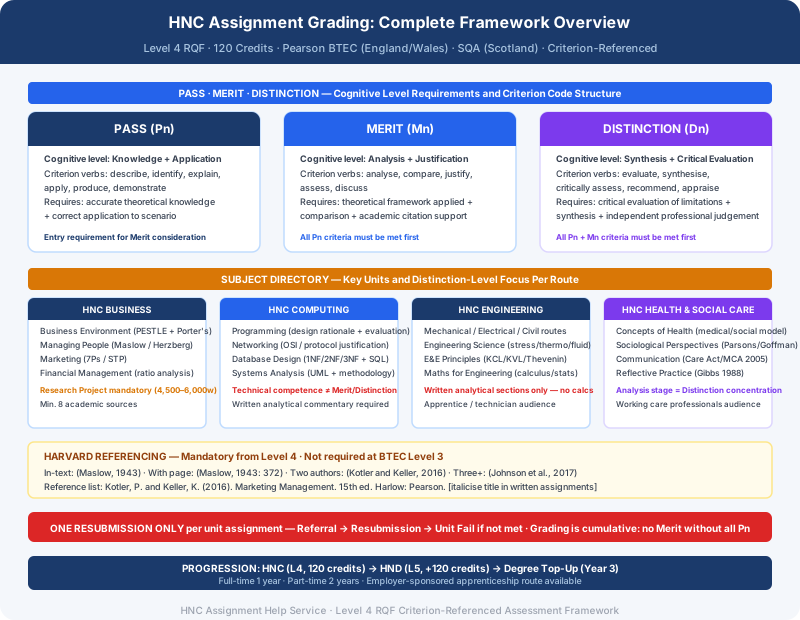
Assessment at Level 4 is entirely criterion-referenced and assignment-based — there are no unseen written examinations at HNC level. Each unit is assessed through an assignment brief issued by the tutor, and students must address every specified criterion in their submitted response. Pearson uses a standardised criterion coding system: Pass criteria are labelled Pn (P1, P2, P3...), Merit criteria Mn (M1, M2...), and Distinction criteria Dn (D1, D2...). Each criterion must be individually addressed; a response that is outstanding overall but omits a specific criterion code will not receive that criterion's grade.
Internally verified assessment means that all submitted work is marked by the student's tutor and then checked by a second internal verifier before grades are confirmed. This process ensures criteria are applied consistently and rigorously — marks that might have been awarded informally at Level 3 are not awarded at Level 4 without explicit criterion evidence. One resubmission opportunity is available if a student receives a referral (fail) on a unit. If the resubmission does not meet the criteria, the unit is failed permanently with no further opportunity.
HNC Pass, Merit, and Distinction Criteria: What Each Grade Requires
The three grade bands at HNC Level 4 represent qualitatively different levels of academic thinking, not simply quantitatively different amounts of the same writing. Understanding this distinction is the most important academic adjustment for students entering Level 4 from BTEC Level 3.
Pass criteria require the student to demonstrate knowledge of the subject area and apply it correctly to the given scenario or brief. This is descriptive and applied writing: defining relevant theories, identifying relevant factors, and showing that the student understands the content. Pass is achievable through well-organised, comprehensive descriptive work.
Merit criteria require the student to move beyond description into analysis. Analytical writing examines why things are the case, how factors relate to each other, what the implications of a finding are, and how competing frameworks compare. Merit-level work justifies choices, compares theories, and provides reasoned argument — it does not simply state what each theory says.
Distinction criteria require synthesis, critical evaluation, independent academic judgement, and professional recommendations. Synthesis means combining insights from multiple frameworks into a coherent conclusion — not treating each theory as a separate item to define and apply. Critical evaluation means assessing the limitations and assumptions of theories and evidence, not just applying them. Independent judgement means reaching a defensible conclusion rather than hedging with "it depends on the situation." Distinction cannot be achieved by writing more — it requires a fundamentally different cognitive approach. Distinction-level language markers include: "critically evaluate," "synthesise across frameworks," "the evidence suggests that," "a limitation of this model is," "recommend with justification," and "having evaluated the competing perspectives."
Students who achieved Merit or Distinction at BTEC Level 3 through detailed, well-organised descriptive writing will typically produce Pass-level work at HNC Level 4 if they write in exactly the same style. This is the central challenge of the Level 3 to Level 4 transition — and it affects the majority of new HNC students in their first unit.
HNC Subjects We Cover: Unit-Specific Assignment Help Across All Areas
The service provides unit-specific guidance across all major HNC subject areas. HNC Business is the highest-enrolment HNC subject and includes Business Environment (PESTLE, Porter's Five Forces), Managing People (Maslow, Herzberg, McGregor Theory X/Y), Marketing (7Ps, STP model), Financial Management (ratio analysis and commentary), and the mandatory Managing a Successful Business Project (4,500–6,000 words, minimum 8 academic sources). HNC Business assignments are submitted as written analytical reports and case study analyses — Harvard referencing is required throughout.
HNC Computing presents a specific challenge: technically competent students frequently underachieve at Merit and Distinction because they focus on the practical output — working code, network diagrams, ER diagrams — without providing the analytical written commentary on design decisions that carries the Merit and Distinction criteria. Guidance covers Programming, Networking, Database Design (1NF, 2NF, 3NF normalisation), and Systems Analysis and Design (UML diagrams, waterfall vs agile methodology evaluation).
HNC Engineering is offered across Mechanical, Electrical/Electronic, and Civil routes. The primary audience is apprentices, technicians, and experienced tradespeople who are technically highly competent but have not been required to write analytical engineering reports. Guidance covers Engineering Science (stress and strain, thermodynamics, fluid mechanics), Electrical/Electronic Principles (Kirchhoff's laws, Thevenin's theorem, circuit analysis), Mathematics for Engineering (written interpretation of calculus and statistical results), and route-specific units.
HNC Health and Social Care is studied primarily by working care professionals — NHS staff, care managers, social work assistants — who bring extensive practice experience but have not previously written at academic Level 4 standard. Guidance covers Concepts of Health and Wellbeing (medical vs social model, Dahlgren and Whitehead health determinants model), Sociological Perspectives (Parsons, Goffman, feminist sociology), Communication in Health and Social Care (Care Act 2014, Mental Capacity Act 2005), Research Methods, and reflective account writing using Gibbs' Reflective Cycle (1988). Additional subjects covered include Construction, Early Years, Art and Design, and Hospitality — each with subject-specific unit guidance.
Harvard Referencing in HNC Assignments: A Level 4 Requirement
Harvard referencing is mandatory for all HNC programmes at Level 4 and above. It is not optional and it is not discipline-specific — every HNC unit assignment requires properly formatted in-text citations and a reference list. The overwhelming majority of students entering HNC from BTEC Level 3 National encounter Harvard referencing for the first time at Level 4, because Level 3 programmes do not require academic citation. This gap alone is responsible for a significant proportion of early HNC referrals.
The in-text citation format is (Author Surname, Year) placed within the sentence before the full stop: for example, (Kotler, 2019) or (NHS England, 2023). For direct quotations, a page number is required: (Maslow, 1954, p.28). The reference list at the end of the assignment uses the format: Author Surname, Initial(s). (Year). Title of Book in Italics. Edition (if not first). Place of Publication: Publisher. For example: Kotler, P. and Keller, K. (2016). Marketing Management. 15th ed. Harlow: Pearson.
Academic sources are required at Level 4: textbooks, peer-reviewed journal articles, and where relevant, authoritative policy documents (NHS, NICE guidelines, Pearson learning materials). Wikipedia, general websites, and company blogs do not meet the academic referencing standard for HNC Level 4. At Distinction level, assessors expect a wider range of academic sources — typically a minimum of 8–12 well-selected references — demonstrating genuine engagement with the academic literature rather than reliance on a single textbook.
Common referencing errors in first HNC submissions include: writing a bibliography (a list of sources read) rather than a reference list (sources actually cited in the text); using footnote citations rather than in-text author-date format; omitting page numbers for direct quotations; and inconsistent formatting across different source types.
HNC Delivery Modes: Full-Time, Part-Time, and Working Professional Students
The HNC is delivered in two primary modes. Full-time delivery typically runs for one academic year and is most common among school leavers and recent BTEC Level 3 graduates who have progressed directly into higher education. Part-time delivery typically runs for two years and is the most common route for working professionals — apprentices in engineering and construction, care workers and NHS staff, IT technicians and junior developers, and business administration professionals who are studying alongside full-time employment.
The part-time student profile creates a specific set of assessment challenges. Multiple unit deadlines accumulate across a two-year programme; assignment submission windows frequently coincide with work pressures, shift patterns, and employer project demands. For apprentices, the HNC may be part of a formal apprenticeship framework with additional workplace assessment requirements running in parallel. Many part-time students have not studied formally for several years before beginning their HNC — the return to academic writing is itself a significant adjustment independent of the Level 4 standard.
HNC programmes are delivered at further education colleges, private providers, and some universities. The awarding body (Pearson BTEC or SQA) sets the assessment criteria, but individual centres issue their own assessment briefs and manage submission deadlines — this means that the specific brief format, word count guidance, and submission windows vary between providers while the underlying Pearson or SQA criteria remain consistent.
HNC Progression: From Level 4 to HND, Degree Top-Up, and Beyond
Completing the HNC at Level 4 (120 credits) provides entry to the Higher National Diploma (HND) at Level 5 (an additional 120 credits, 240 credits total). HND completion at Level 5 provides the basis for entry to Year 3 of a university undergraduate degree — the degree top-up route — enabling students to complete a full bachelor's degree in one further year of study.
Most universities in the UK accept HND graduates for degree top-up entry in the relevant subject area. Russell Group and higher-ranked universities typically set a grade requirement for degree top-up entry — commonly Merit average or above, with some programmes requiring Distinction average. This means that grade performance at HNC Level 4 directly influences the progression options available at the end of the HND and ultimately the university options available for degree completion.
Students who achieve Merit or Distinction across their HNC units are better positioned for competitive HND progression and for university acceptance onto degree top-up programmes. Achieving Distinction criteria from the first unit creates a grade trajectory that strengthens university applications. Conversely, a Pass average at HNC may limit HND progression to lower-ranked providers and restrict degree top-up options. This is why understanding and meeting the Distinction criteria from the outset of the HNC programme has tangible long-term consequences for a student's educational progression.
Which aspect of your HNC is causing the most difficulty — the analytical writing, the referencing, or understanding the distinction criteria for your specific unit? Submit your assignment brief and current draft for targeted guidance.
From BTEC Level 3 to HNC: Understanding the Step Up in Assignment Standards
The most common cause of early HNC referrals is not lack of subject knowledge — it is writing at Level 3 standard for a Level 4 assignment. Students who consistently achieved Merit or Distinction at BTEC Level 3 through well-organised, comprehensive descriptive writing find that the same approach produces only Pass-level results at HNC, because Level 4 Merit and Distinction criteria specifically require analytical and critical writing that was not explicitly demanded at Level 3. The introduction of Harvard referencing compounds this challenge for the majority of new Level 4 students who have never cited academic sources in their previous study.
The transition from descriptive to analytical writing requires a change at the sentence level — not simply writing more, but writing differently. The dedicated transitioning from BTEC Level 3 to HNC page explains exactly what changes and provides worked paragraph comparisons showing the same topic written at Level 3 standard and at Level 4 analytical standard. Subject-specific transition guidance is available for HNC Business assignment guidance, HNC Computing assignment help, HNC Engineering assignment support, and HNC Health and Social Care assignment help.
HNC Assessment Timeline: Resubmissions, Internal Verification, and Deadlines
HNC assignments follow a standardised internal assessment cycle. After submission, the tutor marks the work against the Pearson or SQA criteria for each criterion code. A sample of marked work is then internally verified by a second assessor to ensure consistency. The student receives their grade decision — Pass, Merit, Distinction, or Referral — with written feedback identifying any unmet criteria. If a referral is issued, one resubmission opportunity is available within the window specified by the centre.
The one-resubmission rule creates significant pressure: a student who misunderstands the Level 4 analytical standard on their first submission and produces descriptive Pass-level work when Merit was targeted has one opportunity to correct this. If the resubmission also fails to meet the criteria, the unit is failed permanently. This is why a clear understanding of the HNC merit and distinction criteria before the first submission is more important at Level 4 than at any previous qualification stage.
Frequently Asked Questions About HNC Assignment Help
What is HNC assignment help and what does it include?
HNC assignment help provides expert guidance on completing Level 4 Higher National Certificate assignments issued by Pearson BTEC or SQA. The service covers understanding assessment criteria (Pass, Merit, Distinction), structuring written responses to address each criterion, Harvard referencing, and producing work that meets the analytical standard required at Level 4 — not just descriptive summaries of theory. Unit-specific guidance is available for all major HNC subjects including Business, Computing, Engineering, and Health and Social Care.
Does HNC assignment help cover both Pearson BTEC and SQA qualifications?
Both Pearson BTEC HNC (England and Wales) and SQA HNC (Scotland) are covered. Pearson BTEC HNC is the most common qualification and uses criterion-referenced P/M/D grading with specific Pn, Mn, and Dn codes per unit. SQA HNC uses a similar structure with different unit credit values. Guidance is tailored to the awarding body relevant to the student's programme.
How does Level 4 HNC assessment differ from BTEC Level 3?
Level 4 HNC assessment requires analytical and critical writing that goes beyond the descriptive approach accepted at BTEC Level 3. Distinction criteria at Level 4 demand synthesis across multiple frameworks, critical evaluation of competing perspectives, and evidence-based recommendations — cognitive tasks that were not explicitly required at Level 3. Harvard referencing is introduced at Level 4 and is mandatory, whereas it was not required at Level 3.
Can I get help with a specific HNC unit, not just general assignment writing?
Unit-specific guidance is available across all major HNC subjects including Business, Computing, Engineering, and Health and Social Care. Each subject page provides detailed guidance on the most commonly assessed units, including the specific P/M/D criteria, assessment format (report, essay, case study, reflective account), and the academic writing standards required for each unit type.
Submit Your HNC Assignment Brief for Expert Guidance
Include your subject, unit name, current draft, and the specific criteria you need help addressing. Guidance covers analytical writing, Harvard referencing, P/M/D criterion structure, and distinction-level synthesis and critical evaluation.
Common Questions
Is this service specific to HNC qualifications?
Yes. We specialise exclusively in Pearson BTEC and SQA HNC qualifications at Level 4. Our writers are selected for their specific knowledge of HNC units, marking criteria, and Merit/Distinction grade descriptors — not generic academic writing.
Will my assignment be plagiarism free?
Every assignment is written from scratch and run through Turnitin before delivery. You receive a copy of the originality report alongside your completed work.
How quickly can you complete my assignment?
Standard turnaround is 5–7 days. For urgent orders we offer 24-hour and 48-hour expedited delivery at an additional cost. Contact us to confirm availability for your deadline.
What if I'm not happy with the work?
We offer unlimited free revisions within 14 days of delivery. If we cannot meet your requirements after multiple revisions, we offer a full refund — no questions asked.