
HNC Health and Social Care is studied predominantly by working care professionals — healthcare assistants, support workers, residential care staff, and community health workers — who are completing the qualification alongside employment. The qualification is Level 4 RQF and assesses academic analysis of health and social care theory, legislation, and sociological frameworks. Students who have extensive practical experience of care delivery frequently find that their assignments describe practice from direct experience rather than analysing it through theoretical frameworks, which results in Pass grades where Merit and Distinction require sociological analysis, legislative application, and structured critical reflection.
How HNC Health and Social Care Grades Practical Experience Against Academic Theory
HNC Health and Social Care uses criterion-referenced grading with Pass (Pn), Merit (Mn), and Distinction (Dn) descriptors across each unit. Pass criteria require the student to demonstrate knowledge of relevant health and social care concepts, legislation, and theories — identifying the medical model and social model of health, naming relevant legislation, or describing a sociological perspective. Merit criteria require the student to analyse: applying a sociological theory to explain a specific health inequality, comparing the implications of competing models of health for care planning, or evaluating how a legislative framework changes the responsibilities of a care worker in a specific scenario. Distinction criteria require critical evaluation: appraising the limitations of a theoretical framework, synthesising multiple perspectives to produce a reasoned professional judgement, and evaluating the extent to which legislation is effective in practice.
The transition from Pass to Merit in Health and Social Care assignments requires the student to stop describing their professional experience and start analysing it through named theoretical frameworks. A response that says "in my workplace, we treat everyone with dignity" describes practice. A response that says "the social model of health (Oliver, 1990) situates disability in societal barriers rather than individual impairment, which requires care services to address environmental and attitudinal barriers rather than focus exclusively on clinical management" analyses practice through theory. Both may reflect genuine understanding, but only the second meets Merit criteria.
HNC Health and Social Care Concepts of Health: Medical Model, Social Model, and Inequality Frameworks
Concepts of Health is a core unit that requires students to analyse competing models of health and evaluate how they shape care delivery. The medical model of health defines health as the absence of disease, locates the cause of ill health within the individual, and places the healthcare professional as expert authority in the treatment relationship. The social model of health locates the causes of ill health in social, economic, and environmental conditions — poverty, housing, employment, discrimination — and positions individual agency within structural constraints.
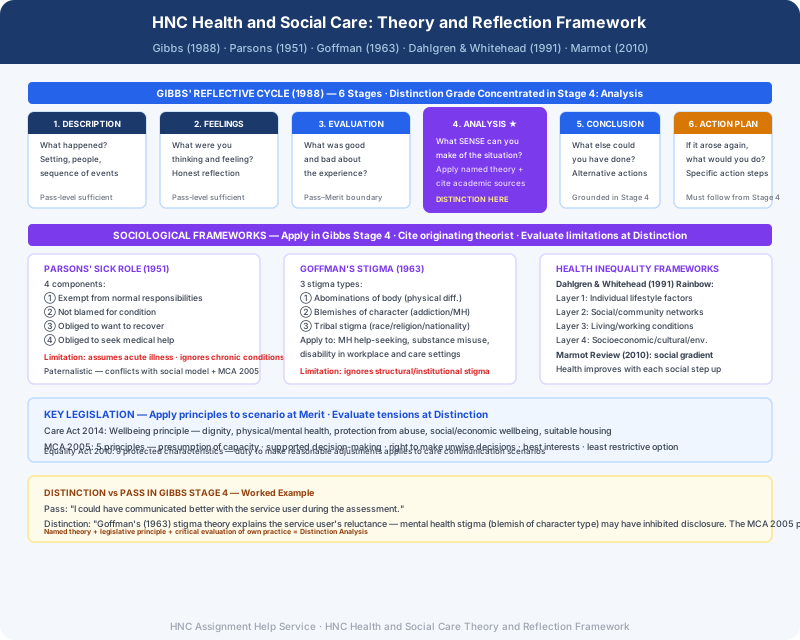
The Dahlgren and Whitehead rainbow model (1991) is the principal framework for analysing health inequalities in HNC Health and Social Care assignments. The model represents health determinants in concentric layers: individual lifestyle factors in the innermost layer; social and community networks; living and working conditions (employment, housing, healthcare access, food production, education, agriculture); and general socioeconomic, cultural, and environmental conditions in the outermost layer. Merit-level analysis applies this framework to explain why health inequalities persist across socioeconomic groups, identifying which determinant layers are implicated in specific inequality patterns. The Marmot Review (2010) provides empirical evidence for the social gradient in health — the finding that health outcomes improve incrementally with each step up the social hierarchy — and is a required reference for assignments addressing health inequality. Distinction-level analysis evaluates the policy implications of these frameworks: what interventions at which levels of the Dahlgren and Whitehead model are most effective, and what the evidence base from the Marmot Review suggests about the limitations of individually-focused health promotion.
HNC Health and Social Care Sociological Perspectives: Parsons, Goffman, and Conflict Theory
Sociological Perspectives assignments require students to apply named sociological theories to health and social care contexts. Parsons' sick role theory (1951) identifies four components of the sick role: the sick person is exempt from normal social responsibilities; the sick person is not held responsible for their condition; the sick person has an obligation to want to recover; and the sick person has an obligation to seek and comply with professional medical help. Merit-level analysis of Parsons' sick role applies it to contemporary care scenarios and evaluates its limitations — the theory assumes acute illness and full recovery, does not account for chronic illness or disability, and reflects a paternalistic model of the doctor-patient relationship that has been substantially revised in contemporary health policy.
Goffman's stigma theory (1963) distinguishes three types of stigma: abominations of the body (physical differences), blemishes of individual character (addiction, mental illness, imprisonment), and tribal stigma (membership of a stigmatised group by race, religion, or nationality). Merit-level application requires the student to analyse how stigma operates in a specific health or social care context — how mental health stigma affects help-seeking behaviour, how stigma associated with substance misuse affects care quality, or how disability stigma operates in workplace and social settings. Distinction-level analysis evaluates Goffman's theory critically: what it captures about social interaction and identity management, and what it does not explain — structural discrimination, institutional stigma, or the role of media in reproducing stigmatising representations. Conflict theory perspectives, including feminist sociology's analysis of gender inequalities in health outcomes and care labour, provide additional analytical frameworks for Distinction-level assignments.
HNC Health and Social Care Communication: Care Act 2014, Mental Capacity Act 2005, and Equality Act 2010
Communication in Health and Social Care assignments require students to analyse communication theory and apply legislative frameworks to care scenarios. The Care Act 2014 establishes the legal framework for adult social care in England, placing the wellbeing principle at the centre of care assessment and planning — local authorities must promote wellbeing when carrying out functions under the Act, with wellbeing defined to include personal dignity, physical and mental health, protection from abuse and neglect, social and economic wellbeing, and suitability of living accommodation. Merit-level application analyses how the wellbeing principle changes communication practice in assessment interviews: what questions the care worker must ask, how the care worker must document preferences and wishes, and what the care worker must do when a person's expressed preferences conflict with family wishes.
The Mental Capacity Act 2005 establishes five statutory principles: a presumption of capacity; the right to be supported in making decisions; the right to make unwise decisions; the best interests test when a person lacks capacity; and the least restrictive option principle. Merit-level analysis applies these principles to specific care communication scenarios — a person with dementia who is refusing medication, a person with a learning disability who wants to make a financial decision, or a person in crisis who is refusing emergency intervention. Distinction-level analysis evaluates the tensions between the MCA 2005 principles in practice: when does protecting someone from an unwise decision cross into paternalism, and how does the best interests test balance personal dignity against physical safety? The Equality Act 2010 protects nine characteristics — age, disability, gender reassignment, marriage and civil partnership, pregnancy and maternity, race, religion or belief, sex, and sexual orientation — and its application to care communication requires Merit-level analysis of specific duty-to-make-reasonable-adjustments scenarios.
HNC Health and Social Care Reflective Practice: Gibbs' Reflective Cycle and the Distinction Analysis Stage
Reflective practice assignments in HNC Health and Social Care use Gibbs' Reflective Cycle (1988) as the primary framework. The six stages are: Description (what happened); Feelings (what were you thinking and feeling); Evaluation (what was good and bad about the experience); Analysis (what sense can you make of the situation); Conclusion (what else could you have done); and Action Plan (if it arose again, what would you do). Each stage has a distinct analytical function and must be addressed with appropriate depth in assignment submissions.
The Analysis stage of Gibbs' Cycle is where Merit and Distinction grades are concentrated. Description, Feelings, and Evaluation stages can be completed at Pass level with accurate and honest account-giving. The Analysis stage requires the student to apply theoretical frameworks to make sense of the experience: why did the interaction unfold as it did, what sociological or psychological theory explains the behaviour observed, what does the literature say about effective practice in this type of scenario, and what does the gap between the student's practice and the theoretical ideal reveal about their professional development needs? A reflective account that reaches the Analysis stage with statements such as "I could have communicated better" rather than analysing why communication failed through a named framework — attachment theory, person-centred communication principles, or a specific legislative duty — does not meet Merit criteria. Distinction-level Analysis synthesises multiple theoretical perspectives to produce a nuanced explanation of the experience and critically evaluates the limitations of each framework applied.
How Does Theory-Based Analysis Differ from Practice-Based Description in Health and Social Care Assignments?
Practice-based description reports what happened in a care context from the perspective of direct experience. Theory-based analysis explains why it happened by connecting the experience to named sociological, psychological, or legislative frameworks and evaluating those connections critically. HNC Health and Social Care Merit and Distinction criteria require theory-based analysis. An assignment that draws exclusively on workplace experience without referencing the theoretical framework the experience illustrates will receive a Pass grade, regardless of the richness or quality of the experience described.
Harvard Referencing for HNC Health and Social Care Assignments
HNC Health and Social Care assignments require Harvard referencing at Level 4. Key sources include: Dahlgren, G. and Whitehead, M. (1991). Policies and Strategies to Promote Social Equity in Health. Stockholm: Institute for Future Studies; Marmot, M. (2010). Fair Society, Healthy Lives: The Marmot Review. London: UCL; Parsons, T. (1951). The Social System. New York: Free Press; Goffman, E. (1963). Stigma: Notes on the Management of Spoiled Identity. New York: Prentice-Hall; Gibbs, G. (1988). Learning by Doing: A Guide to Teaching and Learning Methods. Oxford: Further Education Unit, Oxford Polytechnic. In-text: (Marmot, 2010). Reference list entries must include publisher and place.
Working Care Professionals and the Challenge of Academic Writing at Level 4
HNC Health and Social Care students who are working care professionals bring exceptional practical knowledge to their studies. The challenge at Level 4 is translating that practical knowledge into academic analysis — making explicit the theoretical frameworks that underpin good practice, applying legislative requirements to scenarios analytically rather than procedurally, and evaluating care approaches critically rather than describing them approvingly. The qualification is designed to develop professional reflective practice capacity, which requires the ability to stand outside one's own practice experience and analyse it through an external theoretical lens. This is a specific academic skill that is developed through practice, not assumed from professional experience.
Progression from HNC Health and Social Care to Nursing, Social Work, and Allied Health Professions
HNC Health and Social Care at Level 4 is a recognised pathway into nursing, social work, and allied health profession degree programmes. Many universities accept HNC completion as equivalent to Year 1 of a relevant degree, enabling direct entry to Year 2 of a nursing, social work, or occupational therapy programme. The analytical writing skills and theoretical frameworks developed at HNC level — sociological perspectives, legislative application, reflective practice using Gibbs' Cycle — form the direct foundation for Level 5 and Level 6 academic work in health and social care degree programmes.
What is the Dahlgren and Whitehead rainbow model and how do I use it in assignments?
The Dahlgren and Whitehead rainbow model (1991) represents health determinants in concentric layers from individual lifestyle factors at the centre to broader socioeconomic, cultural, and environmental conditions at the outer ring. In HNC Health and Social Care assignments, use it to analyse why specific health inequalities exist by identifying which determinant layers are implicated. Merit-level analysis names the specific layer — living and working conditions, social and community networks — and explains its mechanism. Distinction-level analysis evaluates the policy implications and the evidence base from the Marmot Review (2010) for interventions at different layers.
Which stage of Gibbs' Reflective Cycle is most important for Merit and Distinction?
The Analysis stage (Stage 4) is where Merit and Distinction grades are concentrated. This stage requires you to apply named theoretical frameworks — sociological theories, psychological models, legislative principles — to explain why the experience unfolded as it did. Description, Feelings, and Evaluation stages can reach Pass level with accurate account-giving, but Analysis requires you to connect the experience to theory and evaluate what that theoretical lens reveals about your professional practice.
How do I apply the Mental Capacity Act 2005 in a Health and Social Care assignment?
Apply the MCA 2005 by working through its five statutory principles in relation to the specific scenario: presumption of capacity, supported decision-making, right to make unwise decisions, best interests test, and least restrictive option. Merit-level application analyses which principles are triggered by the scenario and what they require of the care worker. Distinction-level analysis evaluates the tensions between principles — when does the best interests test risk overriding personal autonomy, and how should care workers navigate that conflict in practice?
What is Parsons' sick role and what are its limitations for HNC assignments?
Parsons' sick role (1951) identifies four components: exemption from normal responsibilities, no personal blame for the condition, obligation to want to recover, and obligation to seek medical help. Its limitations, required for Merit and Distinction analysis, include: it assumes acute illness with full recovery; it does not account for chronic illness, disability, or conditions where recovery is not possible; it reflects a paternalistic medical model that conflicts with contemporary person-centred and social model approaches; and it ignores how stigma, social class, and race affect access to and experience of the sick role.
Submit Your HNC Health and Social Care Assignment Brief
Upload your assignment brief, unit specification, and any tutor feedback. Our HNC Health and Social Care specialists will identify which theoretical frameworks your current submission applies and provide targeted support for Merit and Distinction level analysis.
Common Questions
Is this service specific to HNC qualifications?
Yes. We specialise exclusively in Pearson BTEC and SQA HNC qualifications at Level 4. Our writers are selected for their specific knowledge of HNC units, marking criteria, and Merit/Distinction grade descriptors — not generic academic writing.
Will my assignment be plagiarism free?
Every assignment is written from scratch and run through Turnitin before delivery. You receive a copy of the originality report alongside your completed work.
How quickly can you complete my assignment?
Standard turnaround is 5–7 days. For urgent orders we offer 24-hour and 48-hour expedited delivery at an additional cost. Contact us to confirm availability for your deadline.
What if I'm not happy with the work?
We offer unlimited free revisions within 14 days of delivery. If we cannot meet your requirements after multiple revisions, we offer a full refund — no questions asked.