
HNC Business is the highest-enrolment HNC subject in the Pearson BTEC framework, assessed at Level 4 through criterion-referenced unit assignments graded Pass, Merit, and Distinction. This service provides unit-specific guidance on the five major assessed units and the mandatory research project — with full coverage of the P/M/D criteria structure and Harvard referencing requirements that distinguish Level 4 academic writing from the descriptive approach most students used at BTEC Level 3.
HNC Business Environment Assignment: PESTLE, Porter's Five Forces, and Distinction Criteria
The Business Environment unit is one of the most widely assessed in the HNC Business programme and one of the most frequently cited in early cohort difficulties. It requires students to analyse the external and competitive environment affecting a named business — a task that appears straightforward but is consistently underperformed at Merit and Distinction level because students default to description.
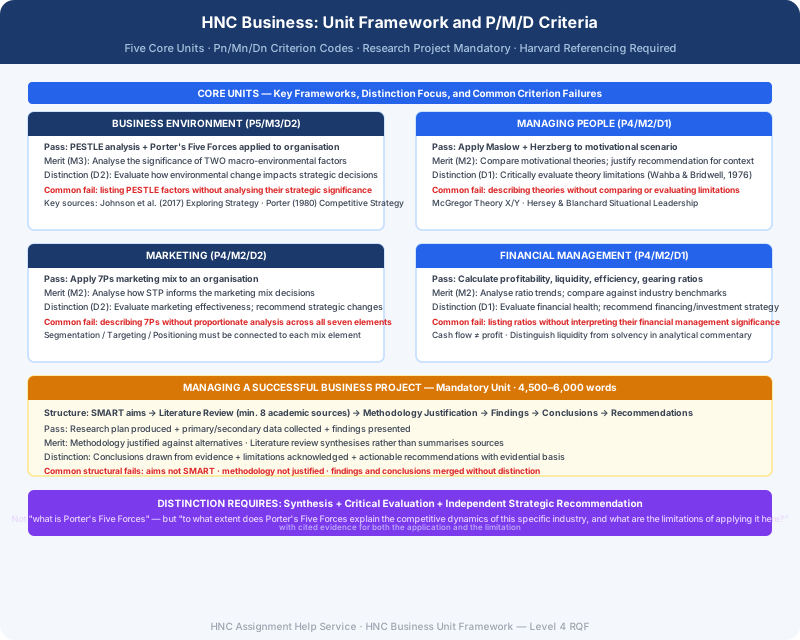
Pass criteria (P5 level) require students to identify and describe environmental factors: PESTLE components (Political, Economic, Social, Technological, Legal, Environmental) applied to a named business, alongside Porter's Five Forces for competitive context. The most common student approach — listing each PESTLE factor with a sentence or two of explanation — meets Pass criteria and does not progress further.
Merit criteria (M3 level) require analysis of the relationships between environmental factors, not just their identification. How does a political factor (corporation tax policy) interact with an economic factor (consumer spending) to affect the business's strategic position? How does the threat of new entrants in Porter's model relate to the technological environment? Merit requires the student to examine connections and evaluate implications — not to list factors in isolation.
Distinction criteria (D2 level) require synthesis of the environmental analysis into strategic conclusions. The student must critically evaluate the implications of the combined environmental and competitive analysis for the organisation's strategic choices, make evidence-based recommendations, and justify those recommendations with academic theory. A student who produces a comprehensive and accurate PESTLE and Porter's analysis but concludes with "the company faces many challenges and opportunities" has not met the Distinction criteria — D2 requires a specific, justified strategic recommendation derived from the synthesis of the analysis. The assessment format is a written analytical report — typically 1,500–2,500 words — with formal report structure (executive summary, analysis sections, conclusion, recommendations, and references).
HNC Managing People Assignment: Motivation Theory, Leadership Models, and Merit/Distinction Writing
The Managing People unit assesses knowledge of HR theory, motivation, and leadership at Level 4. It covers motivational frameworks (Maslow's hierarchy of needs, Herzberg's two-factor theory, McGregor's Theory X/Y) and leadership models (Transformational leadership, Transactional leadership, and Situational Leadership by Hersey and Blanchard). The unit is assessed through a written report or essay — typically 1,500–2,000 words — often using a case study scenario requiring application to a named organisation.
Pass criteria (P4 level) require the student to define the motivation theories and leadership styles: describe Maslow's hierarchy of needs with its five levels, explain Herzberg's distinction between hygiene factors (which prevent dissatisfaction) and motivators (which drive satisfaction and performance), and describe McGregor's Theory X (assumption: workers dislike work and must be controlled) and Theory Y (assumption: workers are self-motivated and seek responsibility). At Pass level, definitions and descriptions are sufficient.
Merit criteria (M2 level) require the student to compare and contrast the motivation theories — not treat each one separately but examine where they agree and differ in their assumptions about employee motivation. Herzberg's two-factor theory and Maslow's hierarchy are related but not identical: Herzberg's hygiene factors roughly correspond to Maslow's lower-level needs, while his motivators correspond to esteem and self-actualisation. Merit requires this analytical connection to be made explicitly. McGregor's Theory X and Y are frequently misunderstood as descriptions of management style — at Merit level, students must clarify that they describe assumptions about human motivation, not management techniques, and justify which assumptions are more applicable to the case study context.
Distinction criteria (D1 level) require critical evaluation of the limitations of these frameworks in contemporary workplace contexts. Maslow's hierarchy has limited empirical support for the strict sequential ordering of needs (Wahba and Bridwell, 1976); Herzberg's two-factor theory was based on a specific professional sample that may not generalise to all workplace contexts. At Distinction, students must synthesise multiple frameworks — acknowledging what each explains and where each falls short — to produce a coherent, evidence-based management recommendation for the specific organisational scenario in the assessment brief.
HNC Marketing Assignment: The 7Ps, Market Segmentation, and Strategic Recommendation
The HNC Marketing unit assesses understanding of marketing theory and its application to real business contexts. It covers the extended marketing mix (7Ps — Product, Price, Place, Promotion, People, Process, Physical Evidence) and the STP model (Segmentation, Targeting, Positioning). Assessment is typically a written marketing report or case study analysis of 1,500–2,500 words.
Pass criteria (P4 level) require the student to define all seven elements of the marketing mix and apply them to a named product or organisation — demonstrating that they understand what each element covers. The most common Pass-level error is over-covering Product and Promotion while under-treating People, Process, and Physical Evidence — all seven elements must receive proportionate, substantive coverage to meet P4.
Merit criteria (M2 level) require analysis of how each element of the marketing mix contributes to the overall marketing strategy, not just definition and description. Comparing the marketing approaches of two organisations — identifying where their 7P decisions differ and analysing why those differences reflect different target markets or strategic positions — is typical M2 work. The STP model must be applied analytically: not just identifying that the company segments by demographic, but evaluating why demographic segmentation was chosen over psychographic or behavioural segmentation for this specific market.
Distinction criteria (D2 level) require critical evaluation of the organisation's marketing strategy effectiveness and synthesis of STP and 7Ps frameworks to produce justified strategic recommendations. At Distinction, the student must evaluate where the current marketing strategy is strong, where it has gaps or misalignments relative to the target segment's needs, and what specific changes to the marketing mix would improve effectiveness — with the recommendation justified by marketing theory and evidence from the case analysis.
HNC Financial Management Assignment: Ratio Analysis, Commentary, and Analytical Depth
The Financial Management unit assesses the ability to interpret financial data and produce analytical commentary — not simply to calculate ratios correctly. The assessment format is typically a financial analysis report of 1,500–2,000 words of written commentary accompanying financial calculations and ratio tables.
Pass criteria (P4 level) require the student to calculate financial ratios from given financial statements: profitability ratios (gross profit margin, net profit margin, return on capital employed), liquidity ratios (current ratio, acid test ratio), efficiency ratios (inventory turnover days, receivables days), and gearing ratios (debt-to-equity). Accurate calculation of ratios meets Pass criteria.
Merit criteria (M2 level) require analytical commentary on what the ratios indicate about the organisation's financial performance. A current ratio of 1.2 is a number; analysing that it is below the recommended benchmark of 1.5, comparing it to the prior year figure of 1.8, and concluding that the organisation's short-term liquidity has deteriorated significantly — with an analysis of what might be causing this — is Merit-level financial analysis. The critical principle is that students who calculate ratios and state whether they are "good" or "bad" achieve Pass at best: Merit requires contextualised analysis with comparison to benchmarks, prior periods, or industry standards.
Distinction criteria (D1 level) require synthesis of the full financial analysis into a strategic evaluation of the organisation's overall financial health, with evidence-based recommendations for financial improvement. The Distinction student must evaluate the organisation's position across all four ratio categories holistically — identifying, for example, that improving profitability metrics are being undermined by deteriorating liquidity, and synthesising this into a coherent assessment of financial risk and a justified set of recommendations. A common Distinction-level gap is missing the cash flow management dimension: a business can show profit on the income statement while experiencing a cash crisis — understanding this distinction is a Merit/Distinction differentiator.
Managing a Successful Business Project: HNC Research Project Guidance
Managing a Successful Business Project is a mandatory unit for HNC Business routes and the most substantial single assignment in the programme. The word count is 4,500–6,000 words — the longest piece of academic work most HNC students have produced at this point in their education. Harvard referencing is mandatory throughout and all sections must individually meet their assessment criteria; a strong data analysis section cannot compensate for a literature review that fails its specific criteria.
The required sections are: project aims and objectives (written in SMART format — Specific, Measurable, Achievable, Realistic, Time-bound); a literature review drawing on a minimum of 8 academic sources (textbooks, business journals, Pearson learning materials — not news articles or business websites); a research methodology section justifying the chosen approach; data collection and analysis; conclusions directly linked back to the original aims and objectives; and strategic recommendations.
The research methodology section is a common source of difficulty. Students must justify whether they are using a quantitative approach (surveys, numerical data, statistical analysis), a qualitative approach (interviews, case studies, thematic analysis), or a mixed methods approach — and explain why the chosen approach is appropriate for the specific research question. Stating "I used questionnaires because they are easy to distribute" does not justify methodology; "a quantitative survey approach was selected because the research question requires measurement of frequency and generalisability across the target population, consistent with a positivist epistemological position" does.
The literature review must demonstrate genuine academic engagement — evaluating and synthesising sources, not merely listing what different authors have said. At Distinction, the literature review itself must evidence critical evaluation: the student identifies gaps in the existing research, evaluates conflicting findings between sources, and synthesises the literature into a coherent theoretical framework that underpins the data collection approach. Common structural failure modes include no clear link between aims, literature review, and conclusions; a literature review that summarises sources without synthesis; and recommendations that do not logically follow from the data analysis findings.
Which HNC Business unit is your immediate priority — the research project, a specific taught unit, or your Harvard referencing standard? Submit your assessment brief and current draft for unit-specific guidance.
Harvard Referencing for HNC Business: Academic Sources and Citation Standards
Harvard referencing in HNC Business assignments requires academic sources — textbooks, peer-reviewed business journals, and Pearson learning materials — cited accurately in-text and in the reference list. For Marketing assignments, key sources include Kotler and Keller's Marketing Management for foundational theory, and Hollensen's Marketing Management for contemporary approaches. For Strategy and Business Environment, Johnson, Scholes, and Whittington's Exploring Strategy is the primary academic reference. For motivation theory in Managing People, the original Maslow (1954) paper or Herzberg's (1959) The Motivation to Work carries more academic weight than a secondary source description of the same theories.
The distinction between grey literature (government reports, industry publications, company annual reports) and peer-reviewed academic sources matters at Distinction level. For the research project, using only grey literature and web sources when academic journal articles are available signals limited literature engagement — assessors at Distinction level expect genuine engagement with the academic research base. The HNC Level 4 assignment standards overview explains the referencing requirement in the context of the full qualification framework. For students arriving from BTEC Level 3 to HNC Business, Harvard referencing is typically the first new academic skill required.
Achieving Distinction in HNC Business: Synthesis, Critical Evaluation, and Strategic Thinking
Distinction in HNC Business assignments requires three specific analytical behaviours that are absent from Pass and Merit responses. Synthesis means connecting multiple frameworks into a single coherent strategic conclusion — not applying PESTLE, then Porter's Five Forces, then SWOT as three separate analyses, but integrating the findings across all three into a unified strategic assessment. Synthesis produces analytical conclusions that could not have been drawn from any single framework alone. Critical evaluation means assessing the limitations of the frameworks used — not just applying PESTLE to the business, but evaluating whether PESTLE captures the most significant factors in this specific business context, acknowledging what it misses, and explaining what additional analytical tools would fill those gaps. Strategic recommendation means producing a specific, justified action recommendation — not "the company should improve its marketing," but a specific recommendation with a justification grounded in the synthesis of the analysis.
These behaviours apply across all Business units but are most visible in the HNC Level 4 analytical standards and the Managing a Successful Business Project research project, where the Distinction criteria explicitly require synthesis and critical evaluation as the final analytical stage. Students who produce strong Merit-level analytical responses but do not reach synthesis — treating each analytical section as a separate task — consistently finish at Merit grade despite the quality of their individual sections.
Frequently Asked Questions About HNC Business Assignment Help
Which HNC Business units does this service cover?
All major Pearson BTEC HNC Business units are covered, including Business Environment (P5/M3/D2), Managing People (P4/M2/D1), Marketing (P4/M2/D2), Financial Management (P4/M2/D1), and the mandatory research project Managing a Successful Business Project. Guidance is unit-specific, addressing the exact Pass, Merit, and Distinction criteria stated in the Pearson assessment brief for each unit.
What is the difference between Merit and Distinction in HNC Business assignments?
Merit criteria require analysis and justification — examining relationships between factors, comparing theories, and justifying their application to the given context. Distinction criteria require synthesis and critical evaluation — combining insights from multiple frameworks into a coherent strategic conclusion, evaluating the limitations of the theories used, and producing evidence-based recommendations. Writing more does not achieve Distinction; a different cognitive approach — synthesis rather than sequential application — is required.
How long is the Managing a Successful Business Project and what must it include?
The Managing a Successful Business Project is 4,500–6,000 words and is a mandatory HNC Business unit. It requires project aims and objectives in SMART format, a literature review with a minimum of 8 academic sources, a justified research methodology, data collection and analysis, conclusions linked to the original aims, and strategic recommendations. Harvard referencing is mandatory throughout the entire project document.
Does HNC Business require Harvard referencing in every assignment?
Harvard referencing is required in all HNC Business unit assignments at Level 4. Academic sources — textbooks and peer-reviewed journals — are expected, particularly at Merit and Distinction level. The research project requires a minimum of 8 academic references. Students from BTEC Level 3 Business who have not previously used Harvard referencing should prioritise learning the format from their first HNC unit to avoid early referrals.
Submit Your HNC Business Assignment Brief for Expert Guidance
Include your unit name, Pearson criterion codes from your brief, current draft, and the specific section you need help with. Guidance covers analytical framework application, distinction-level synthesis, research project structure, and Harvard referencing for Business.
Common Questions
Is this service specific to HNC qualifications?
Yes. We specialise exclusively in Pearson BTEC and SQA HNC qualifications at Level 4. Our writers are selected for their specific knowledge of HNC units, marking criteria, and Merit/Distinction grade descriptors — not generic academic writing.
Will my assignment be plagiarism free?
Every assignment is written from scratch and run through Turnitin before delivery. You receive a copy of the originality report alongside your completed work.
How quickly can you complete my assignment?
Standard turnaround is 5–7 days. For urgent orders we offer 24-hour and 48-hour expedited delivery at an additional cost. Contact us to confirm availability for your deadline.
What if I'm not happy with the work?
We offer unlimited free revisions within 14 days of delivery. If we cannot meet your requirements after multiple revisions, we offer a full refund — no questions asked.