
HNC Engineering is delivered across three principal routes — Mechanical Engineering, Electrical and Electronic Engineering, and Civil Engineering — each assessed through a combination of practical tasks, calculations, and written analytical reports. Engineering students who produce accurate calculations and correct technical diagrams frequently find that their written analytical commentary does not meet Merit or Distinction criteria because it describes results rather than interpreting them. This service provides support for the written analytical report sections of HNC Engineering assignments. It does not assist with calculations, mathematical derivations, or technical laboratory work.
How HNC Engineering Assessment Distinguishes Calculation from Analytical Writing
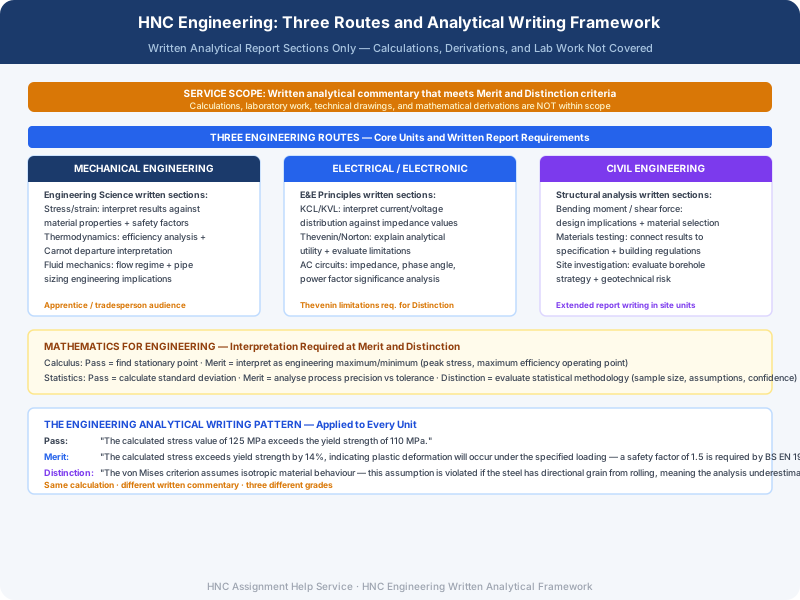
HNC Engineering assignments at Level 4 RQF assess technical competence and analytical writing as separate components within the same criterion-referenced framework. Pass criteria (Pn) typically require the student to perform specified calculations correctly, produce accurate technical drawings or diagrams, or demonstrate a specific practical procedure. Meeting every Pass criterion is the prerequisite for Merit consideration. Merit criteria (Mn) require the student to analyse the engineering significance of their results: what do the calculated values mean for the design or system being analysed, how do they compare to industry standards or theoretical predictions, and what factors influenced the outcome? Distinction criteria (Dn) require critical evaluation: appraising the assumptions made in the analysis, identifying sources of error or uncertainty, and recommending design improvements or alternative approaches with engineering justification.
The practical consequence of this structure is that an engineering student can perform all calculations correctly, arrive at accurate answers, and still receive a Pass grade if the written report section does not meet Merit and Distinction criteria. Analytical writing in engineering assignments requires the student to interpret results in terms of engineering principles, connect numerical outcomes to material properties or system behaviour, and evaluate the implications of findings for real engineering applications. A calculation with no interpretation is a Pass. A calculation followed by analysis that explains what the result means for the engineering system being studied is the foundation of Merit.
HNC Engineering Science: Stress, Strain, Thermodynamics, and Fluid Mechanics Analytical Reports
Engineering Science is a core unit across HNC Engineering routes. The written analytical sections of this unit require students to interpret the results of stress and strain calculations in terms of material behaviour, failure modes, and design safety factors. A Pass-level report states the calculated stress value and confirms whether it exceeds the material's yield strength. A Merit-level report analyses why that stress distribution occurs given the loading conditions and geometry, compares the calculated safety factor to industry standards for the application, and explains what material property — Young's modulus, tensile strength, ductility — is the critical design constraint.
Thermodynamics sections of Engineering Science require similar analytical interpretation. Calculating the efficiency of a thermodynamic cycle meets Pass criteria. Analysing why the calculated efficiency departs from the theoretical Carnot efficiency, identifying the irreversibilities in the real cycle, and evaluating the engineering trade-offs between efficiency and practical constraints — cost, weight, operating temperature range — meets Merit and Distinction criteria respectively. Fluid mechanics analytical writing follows the same pattern: stating the calculated flow velocity or pressure drop is a Pass; interpreting that result in terms of the Reynolds number, laminar versus turbulent flow regime, and the implications for pipe sizing and pump selection is Merit; critically evaluating the assumptions in the Bernoulli equation application and their effect on result accuracy is Distinction.
HNC Electrical and Electronic Principles: Kirchhoff's Laws, Thevenin's Theorem, and Circuit Analysis Reports
Electrical and Electronic Principles assignments require written analytical commentary on circuit analysis results. Applying Kirchhoff's Current Law and Kirchhoff's Voltage Law to solve a network and arriving at correct current and voltage values meets Pass criteria. Merit-level analytical writing explains the physical significance of those values: why the current distribution between parallel branches reflects the relative impedances, what the calculated node voltages indicate about the power distribution in the circuit, and how the results would change if a specific component value were altered. This analytical interpretation requires the student to connect the mathematical results to the physical behaviour of the circuit.
Thevenin's theorem and Norton's theorem are assessed at Merit and Distinction levels in terms of the student's ability to explain why these equivalent circuit representations are analytically useful, not merely apply them correctly. A Merit-level response analyses the advantage of Thevenin equivalent circuit analysis for load variation problems: by reducing a complex network to a single equivalent voltage source and series resistance, the effect of changing the load impedance can be calculated without re-solving the full network. A Distinction-level response evaluates the limitations of Thevenin's theorem — the conditions under which it applies, the assumptions it makes about linearity and bilateral network elements, and the circumstances in which Norton's equivalent representation is more appropriate. AC circuit analysis involving impedance, phase angles, and power factor requires the same structure: calculation at Pass level, interpretation at Merit, critical evaluation of assumptions and limitations at Distinction.
HNC Mathematics for Engineering: Calculus and Statistics Interpretation in Written Reports
Mathematics for Engineering at HNC level assesses both computational ability and the capacity to interpret mathematical results in an engineering context. Differentiating a function and finding a stationary point meets Pass criteria. Interpreting that stationary point as a maximum or minimum in the engineering context — the point of maximum stress in a beam under loading, the operating point of maximum efficiency in a system, or the time of peak power demand — meets Merit criteria. The analytical writing requirement is to explain what the mathematical result means for the engineering application, not simply to state the mathematical result correctly.
Statistics applications in engineering — standard deviation of measurement data, confidence intervals for test results, correlation analysis between variables — follow the same analytical writing requirement. Calculating a standard deviation meets Pass criteria. Analysing what that standard deviation indicates about the precision of a manufacturing process, whether it falls within acceptable tolerances, and what quality control action it implies meets Merit criteria. Distinction-level writing evaluates the statistical methodology itself: whether the sample size is sufficient for the confidence interval to be meaningful, what assumptions the statistical test makes, and whether those assumptions are met by the data collected.
HNC Civil Engineering Route: Structural Analysis, Materials, and Site Investigation Reports
HNC Civil Engineering written assignments cover structural analysis, construction materials, and site investigation reporting. Structural analysis reports at Merit level require analysis of the design implications of calculated bending moments, shear forces, and deflections — connecting numerical results to structural behaviour, material selection criteria, and building regulations. Materials testing reports at Merit level require analysis of how test results — compressive strength of concrete, tensile test results for steel, CBR values for subgrade soil — relate to specification requirements and the design assumptions made for the structure.
Site investigation reports at Distinction level require critical evaluation of the investigation methodology: whether the number and spacing of boreholes is adequate for the site conditions identified, what geological features may have been missed by the investigation strategy, and what additional testing would reduce the geotechnical risk for the proposed foundation design. This level of critical evaluation requires the student to reason about engineering uncertainty and risk rather than simply report findings — the characteristic distinction between Merit and Distinction analytical writing in Civil Engineering assignments.
What Does Analytical Writing Look Like in an Engineering Assignment Report?
Analytical writing in an engineering report connects numerical results to engineering principles, compares outcomes to relevant standards or theoretical predictions, and interprets the significance of findings for the system being analysed. It uses engineering terminology precisely, cites academic or industry standards where appropriate, and explains cause-and-effect relationships rather than reporting facts in sequence. The question analytical writing answers is not "what did the calculation produce?" but "what does this result mean, why does it occur, and what are its engineering implications?"
Harvard Referencing for HNC Engineering Assignments
HNC Engineering assignments require Harvard referencing at Level 4. Engineering-specific academic sources include Hibbeler, R.C. (2018). Engineering Mechanics: Statics. 14th ed. Harlow: Pearson; Cengel, Y.A. and Boles, M.A. (2018). Thermodynamics: An Engineering Approach. 9th ed. New York: McGraw-Hill; and British Standards Institution publications for relevant codes and specifications. In-text citation: (Hibbeler, 2018). For specific content with page evidence: (Hibbeler, 2018: 45). Reference list entries must include edition and publisher.
HNC Engineering and the Apprenticeship Pathway
Many HNC Engineering students are working as apprentices or technicians, completing their qualification alongside employment. The written analytical report sections of HNC assignments are often the most challenging component for students who are technically competent in the workshop, laboratory, or field but have less experience with academic writing requirements. The gap between practical engineering skill and academic analytical writing is not a reflection of engineering ability — it is a specific writing skill that requires development. HNC Engineering assignments assess the capacity to communicate technical analysis in a structured written format, a professional competency required at engineering technician and incorporated engineer level.
Progression from HNC Engineering to HND and Degree
HNC Engineering is Level 4 RQF and contributes 120 credits toward the 240 credits required for HND Engineering at Level 5. Students who complete HNC Engineering can progress to HND Engineering, which typically takes one additional year full-time or two years part-time. HND Engineering, in turn, qualifies students for degree top-up programmes at universities offering accredited engineering degrees recognised by the Engineering Council. The written analytical report skills developed at HNC level form the foundation for the extended independent project and dissertation work required at HND and degree level.
My HNC Engineering calculations are correct but I keep getting Pass grades. What am I missing?
Correct calculations meet Pass criteria (Pn) but not Merit criteria (Mn). Merit requires written analysis of what your results mean in terms of engineering principles — why the stress distribution occurs given the loading and geometry, what the calculated efficiency departure from theoretical performance indicates about the system, or how the numerical result relates to material properties and design safety factors. If your report states results without interpreting their engineering significance, you will receive a Pass regardless of calculation accuracy.
Does this service help with engineering calculations?
No. This service provides support for the written analytical report sections of HNC Engineering assignments only. We do not assist with calculations, mathematical derivations, laboratory work, or technical drawings. The service is specifically for students who have completed the technical components of their assignments and need support developing the analytical writing commentary that meets Merit and Distinction criteria.
What is Thevenin's theorem and how do I write about it at Distinction level?
Thevenin's theorem states that any linear bilateral network can be replaced by an equivalent circuit consisting of a voltage source (Vth) in series with an impedance (Zth). At Distinction level, analytical writing about Thevenin's theorem must evaluate its limitations: it applies only to linear, bilateral networks; it assumes the network contains no dependent sources that change with the load; and it becomes less accurate when network elements have significant frequency dependence. Distinction writing also compares Thevenin's and Norton's equivalent representations and evaluates when each is more analytically useful.
Which HNC Engineering route has the most written assignment content?
All three HNC Engineering routes — Mechanical, Electrical and Electronic, and Civil — include significant written analytical report components across the Engineering Science, Principles, and Mathematics for Engineering units. The proportion of written analytical work relative to practical assessment varies by unit and centre delivery, but all routes require written analytical commentary on technical results to achieve Merit and Distinction grades. Civil Engineering tends to have more extended report-writing components in site investigation and materials units.
Submit Your HNC Engineering Assignment Brief
Upload your assignment brief, unit specification, and any results or technical work already completed. Our HNC Engineering specialists will identify which criteria your written analytical sections currently meet and provide targeted support for Merit and Distinction level commentary.
Common Questions
Is this service specific to HNC qualifications?
Yes. We specialise exclusively in Pearson BTEC and SQA HNC qualifications at Level 4. Our writers are selected for their specific knowledge of HNC units, marking criteria, and Merit/Distinction grade descriptors — not generic academic writing.
Will my assignment be plagiarism free?
Every assignment is written from scratch and run through Turnitin before delivery. You receive a copy of the originality report alongside your completed work.
How quickly can you complete my assignment?
Standard turnaround is 5–7 days. For urgent orders we offer 24-hour and 48-hour expedited delivery at an additional cost. Contact us to confirm availability for your deadline.
What if I'm not happy with the work?
We offer unlimited free revisions within 14 days of delivery. If we cannot meet your requirements after multiple revisions, we offer a full refund — no questions asked.