
HNC Computing assignments divide into two distinct assessment types: practical tasks that demonstrate technical competence, and written analytical sections where Merit and Distinction grades are awarded. Students who build working code, configure network topologies, or write functional SQL queries frequently receive Pass grades because their written commentary describes what they did rather than analysing why they made particular design decisions. This service provides support for the written analytical sections of HNC Computing units at Level 4 RQF.
How HNC Computing Grades Technical Competence Separately from Analytical Writing
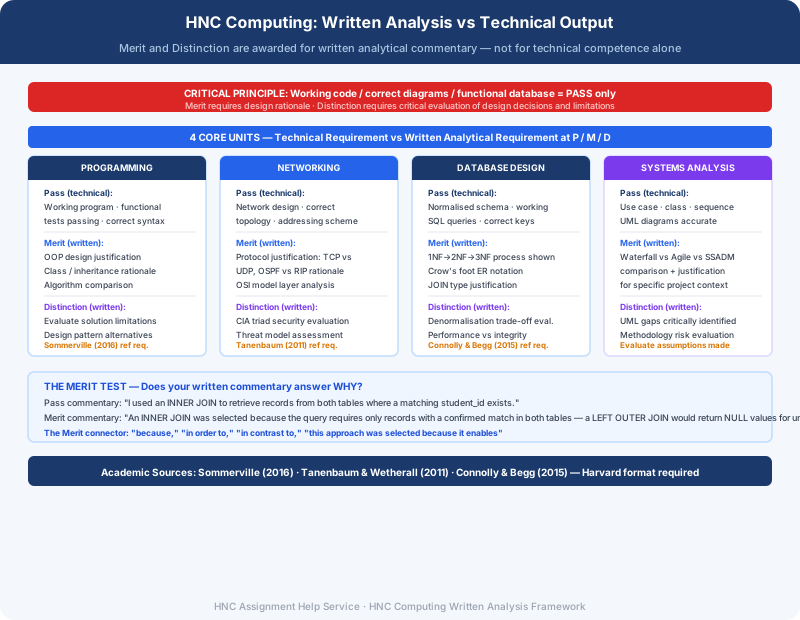
Pearson BTEC HNC Computing uses criterion-referenced grading across Pass, Merit, and Distinction descriptors. Pass criteria (Pn) require students to produce a working technical outcome — functioning code, a configured network, a normalised database schema, or a completed UML diagram. Meeting every Pass criterion is the entry requirement for Merit. Merit criteria (Mn) require the student to analyse their technical decisions: why a particular algorithm was chosen over alternatives, why a specific network topology suits the given organisational context, or why normalisation to third normal form was appropriate rather than second. Distinction criteria (Dn) require critical evaluation: appraising the limitations of the solution produced, comparing methodological alternatives with justified reasoning, and demonstrating independent professional judgement about what should be done differently.
The grading consequence is that a student who submits working code with no design rationale receives a Pass. Adding a paragraph that describes what the code does does not change the grade. Merit requires the student to shift from descriptive commentary to analytical writing: sentences that connect design decisions to computing principles, compare alternative approaches, and justify the chosen solution against stated criteria. Distinction requires that analytical foundation to extend into critical evaluation — identifying where the solution succeeds, where it fails, and what a superior solution would require.
HNC Computing Programming Unit: From Working Code to Distinction-Level Design Analysis
The Programming unit at HNC Computing assesses three cognitive levels aligned to the Pass, Merit, and Distinction descriptors. At Pass level, the requirement is a working program that meets the specified functional requirements — correct syntax, expected outputs, and evidence of testing. At Merit level, the requirement shifts to design analysis: the written report must explain the object-oriented design decisions made, justify the use of specific classes, inheritance structures, or data structures against the problem requirements, and compare the chosen approach with at least one alternative. Academic sources such as Sommerville's Software Engineering provide the theoretical foundation for design justification. At Distinction level, the student must critically evaluate the solution: where does the design fail to scale, what refactoring would improve maintainability, and what design patterns — Singleton, Factory, Observer — would have addressed identified weaknesses.
The distinction between Merit and Distinction in Programming assignments commonly comes down to whether the student evaluates their own solution critically or only justifies it. Justification argues why the chosen approach is appropriate. Critical evaluation argues why the chosen approach is appropriate, identifies its limitations with specific examples from the code produced, and proposes alternative approaches with theoretical grounding. Both claims require citation to computing literature rather than unsupported assertion.
HNC Computing Networking Unit: OSI Model, Protocol Justification, and Security Evaluation
HNC Computing Networking assignments require students to design or evaluate network architectures, justify protocol choices, and assess security implementations. Pass criteria require an accurate network design that meets the specified requirements — correct topology, appropriate addressing scheme, and identification of hardware components. Merit criteria require protocol justification: why TCP rather than UDP for the application layer, why OSPF rather than RIP for the routing protocol in the given organisational context, why a star topology over mesh for the specified scale. Each justification must connect the protocol or topology characteristic to the specific network requirement — Tanenbaum's Computer Networks provides the theoretical framework for protocol analysis.
Distinction criteria require security evaluation: assessing the proposed network design against identified threat vectors, evaluating the effectiveness of implemented controls such as firewall rules, VLAN segmentation, or intrusion detection systems, and recommending improvements with justification. Network security evaluation at Distinction level requires the student to demonstrate understanding of the CIA triad — Confidentiality, Integrity, Availability — and assess the proposed design against each dimension. A security recommendation that simply names a firewall without evaluating its effectiveness against the specific threat model does not meet Distinction criteria.
HNC Computing Database Design: Normalisation, ER Diagrams, and SQL Justification
Database Design assignments at HNC Computing assess the ability to produce a normalised relational schema, represent it in an Entity-Relationship diagram, and implement it in SQL. Pass criteria require a functional database with correctly structured tables, appropriate primary and foreign keys, and working SQL queries that return expected results. Merit criteria require normalisation analysis: the written report must demonstrate the process of normalisation from unnormalised form through first normal form (1NF), second normal form (2NF), and third normal form (3NF), showing what functional dependencies were identified and why each normalisation step was applied. Connolly and Begg's Database Systems is the standard academic reference for normalisation theory at HNC level.
ER diagrams at Merit level must use crow's foot notation accurately, representing cardinality constraints — one-to-one, one-to-many, many-to-many — and identifying mandatory versus optional participation. SQL JOIN syntax must be justified in the written commentary: the distinction between INNER JOIN, LEFT OUTER JOIN, and RIGHT OUTER JOIN must be explained in terms of which records are included or excluded and why that behaviour is appropriate for the specific query requirement. Distinction criteria require critical evaluation of the database design: identifying where denormalisation might be appropriate for performance reasons in a specific use case, evaluating the trade-offs between normalisation and query efficiency, and recommending design improvements with theoretical justification.
HNC Computing Systems Analysis: UML Notation, Methodology Comparison, and SSADM
Systems Analysis assignments require students to model a system using UML notation and justify their choice of development methodology. Pass criteria require accurate UML diagrams: a use case diagram showing actors and system boundaries, a class diagram showing attributes and associations, and a sequence diagram showing object interaction across a specific use case. Merit criteria require methodology comparison: the written report must compare waterfall, agile, and SSADM approaches for the given project context, analysing the characteristics of each methodology against the specific requirements — project scale, team structure, requirements stability, and client involvement.
Distinction criteria require critical evaluation of both the UML models produced and the recommended methodology. UML evaluation at Distinction level identifies where the use case diagram oversimplifies actor relationships, where the class diagram fails to model inheritance hierarchies accurately, or where the sequence diagram omits significant system interactions. Methodology evaluation at Distinction level goes beyond identifying which methodology is most suitable to assessing the risks of that choice: what assumptions about requirements stability does waterfall make, and what happens if those assumptions fail? How does agile sprint planning change when the client stakeholder is unavailable for regular review? What does SSADM's structured approach to feasibility study and requirements definition offer that agile does not? These critical evaluations, supported by academic sources, distinguish Distinction from Merit in Systems Analysis assignments.
What Is the Difference Between a Technical Report and an Analytical Report in HNC Computing?
A technical report documents what was built and how it works. An analytical report explains why design decisions were made, compares alternatives, and evaluates outcomes against stated criteria. HNC Computing Merit and Distinction grades are awarded for analytical writing, not technical documentation. Students who write technically accurate descriptions of their systems without connecting those descriptions to computing principles, design rationale, or theoretical frameworks typically receive Pass grades regardless of the quality of the technical work produced.
Harvard Referencing for HNC Computing Assignments
HNC Computing assignments require Harvard referencing from Level 4 onwards. Key academic sources cited in computing units include Sommerville, I. (2016). Software Engineering. 10th ed. Harlow: Pearson; Tanenbaum, A.S. and Wetherall, D. (2011). Computer Networks. 5th ed. Upper Saddle River: Pearson; and Connolly, T. and Begg, C. (2015). Database Systems. 6th ed. Harlow: Pearson. In-text citation format: (Sommerville, 2016). For a specific argument supported by page evidence: (Sommerville, 2016: 14). Reference list entries must include edition, publisher, and place of publication.
Common Merit Criterion Failures in HNC Computing Assignments
The most frequent Merit criterion failure in HNC Computing assignments is description substituted for analysis. Describing that a three-tier architecture was used does not meet a Merit criterion that requires analysis of the design decision. Stating that TCP provides reliable delivery does not meet a Merit criterion that requires justification of protocol selection for a specific application context. Producing a class diagram does not meet a Merit criterion that requires analysis of the object-oriented design decisions reflected in that diagram. Merit requires the analytical connector — "because," "in order to," "in contrast to," "this approach was selected because it enables" — between the technical fact and the design principle it reflects.
HNC Computing and the Transition from Practical to Professional Thinking
The transition from HNC Computing to professional computing practice requires the ability to communicate technical decisions to non-technical stakeholders. The written analytical sections of HNC Computing assignments develop this professional communication skill. A software developer who can write working code but cannot explain why their design decisions are appropriate, what their limitations are, and what alternatives were considered is less professionally effective than one who can. HNC Computing assignments assess this professional communication capacity through Merit and Distinction criteria. Students who treat the written sections as administrative requirements attached to technical work are misunderstanding what the qualification is measuring.
Why did my HNC Computing assignment receive a Pass when my code works correctly?
A working program meets Pass criteria (Pn) but not Merit criteria (Mn). Merit requires written analysis of your design decisions — why you chose a particular algorithm, data structure, or architecture over alternatives. If your written commentary describes what the code does rather than analysing why you designed it that way, you will receive a Pass regardless of the technical quality of the code. Merit and Distinction are awarded for the quality of analytical writing, not for the quality of the technical output alone.
What academic sources should I cite in HNC Computing assignments?
Standard academic sources for HNC Computing include Sommerville's Software Engineering for programming and systems analysis units, Tanenbaum and Wetherall's Computer Networks for networking units, and Connolly and Begg's Database Systems for database design units. All sources must be cited in Harvard format. In-text: (Sommerville, 2016). Reference list: Sommerville, I. (2016). Software Engineering. 10th ed. Harlow: Pearson.
How do I write a Distinction-level evaluation in an HNC Computing assignment?
Distinction-level evaluation requires identifying the limitations of the solution you produced, not only justifying why it is appropriate. For a database design, this means evaluating where the normalised schema might require denormalisation for performance, and justifying that trade-off with theoretical reasoning. For a networking assignment, this means evaluating the security gaps in the proposed design and recommending specific improvements. Distinction writing uses verbs like "critically evaluate," "assess the limitations of," and "appraise the extent to which" rather than simply "justify" or "compare."
What is the difference between waterfall, agile, and SSADM in HNC Systems Analysis?
Waterfall is a sequential development methodology where each phase — requirements, design, implementation, testing, deployment — must be completed before the next begins. It suits projects with stable, well-defined requirements. Agile uses iterative sprints with regular client review, suits projects where requirements evolve. SSADM (Structured Systems Analysis and Design Method) is a formal UK government methodology using structured stages including feasibility study, requirements analysis, and logical and physical design specifications. HNC Systems Analysis assignments require you to compare these methodologies against specific project characteristics and justify your recommendation.
Submit Your HNC Computing Assignment Brief
Upload your assignment brief, unit specification, and any tutor feedback from previous attempts. Our HNC Computing specialists will assess which criteria your current submission meets and provide targeted support for the analytical writing sections that determine your Merit or Distinction grade.
Common Questions
Is this service specific to HNC qualifications?
Yes. We specialise exclusively in Pearson BTEC and SQA HNC qualifications at Level 4. Our writers are selected for their specific knowledge of HNC units, marking criteria, and Merit/Distinction grade descriptors — not generic academic writing.
Will my assignment be plagiarism free?
Every assignment is written from scratch and run through Turnitin before delivery. You receive a copy of the originality report alongside your completed work.
How quickly can you complete my assignment?
Standard turnaround is 5–7 days. For urgent orders we offer 24-hour and 48-hour expedited delivery at an additional cost. Contact us to confirm availability for your deadline.
What if I'm not happy with the work?
We offer unlimited free revisions within 14 days of delivery. If we cannot meet your requirements after multiple revisions, we offer a full refund — no questions asked.